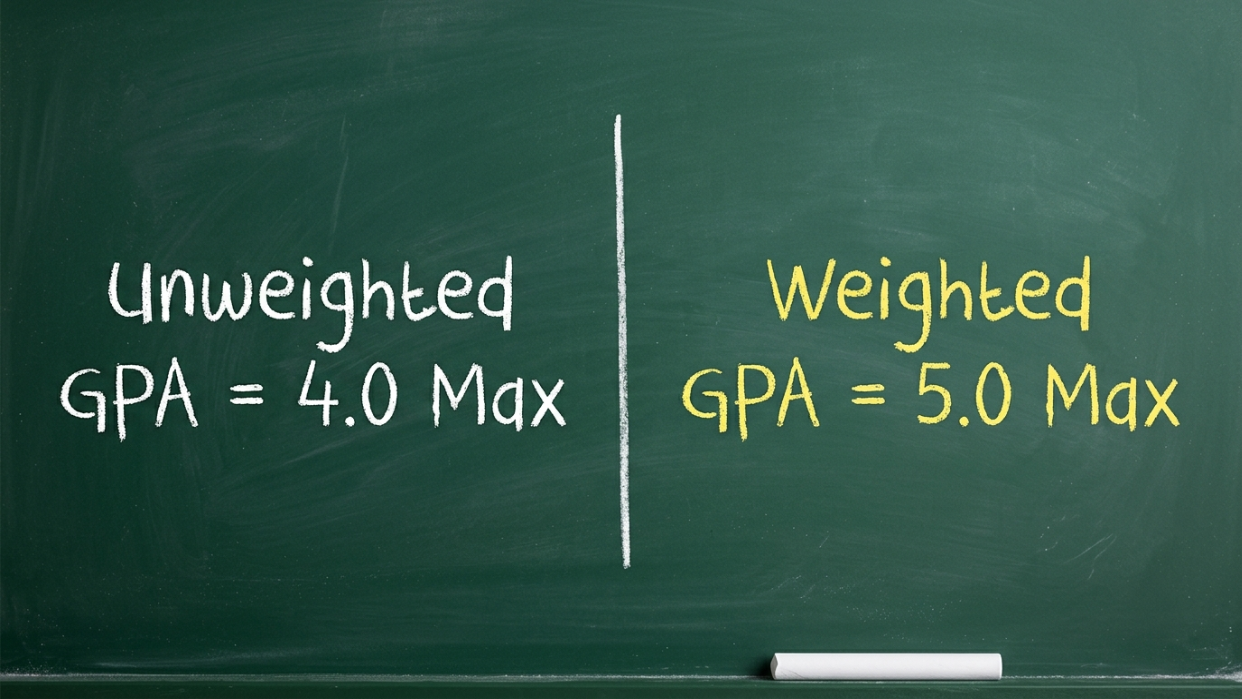
Weighted GPA gets the top score at 5.0, yet more weight is given to AP, Honors, and IB classes, kinda like they matter more. Meanwhile Unweighted GPA caps out at 4.0, and it doesn’t assign any extra credit to any course type. The admissions office looks at both GPAs but they usually treat weighted GPA as higher, since it can measure your self challenge level a bit better.
This guide should help you parse each scale, show conversion tables, uncover the college preference, and figure out what matters most.
What Is an Unweighted GPA? The Simple Explanation
Let me start with the unweighted GPA because it is easier to understand.
Unweighted GPA runs on the basic 4.0 scale. Each class is treated the same, kinda flat weight, no extra emphasis. So whether it’s P.E. or AP Calculus, it really doesn’t matter much , an “A” is 4.0 points, a “B” hits 3.0 points, and after that it continues in the same way.
Here is the unweighted scale:
| Letter Grade | GPA Points |
| A+ or A | 4.0 |
| A- | 3.7 |
| B+ | 3.3 |
| B | 3.0 |
| B- | 2.7 |
| C+ | 2.3 |
| C | 2.0 |
| D | 1.0 |
| F | 0.0 |
The highest possible unweighted GPA is 4.0. Like that means you got straight A’s in every single class, no exceptions, mostly. When someone asks what a 4.0 GPA is, this is what they mean , basically. A 4.0 on the unweighted scale is perfect, plain and simple. No B’s. No C’s. Just A’s again. And when they ask what is a 4.0 GPA scale, they are talking about that 0.0 to 4.0 range, where 4.0 is the top limit.
What Is a Weighted GPA? The Complete Breakdown
Now let me explain the weighted GPA. This one is a bit more complicated but very important.
A weighted GPA can go above 4.0, it usually reaches like 5.0 or even higher depending on your school. Weighted GPAs also give extra credit for tougher coursework, like AP (Advanced Placement) Honors, or IB (International Baccalaureate) , which is basically the same idea, just with a different emphasis.
Here is a typical weighted scale:
| Letter Grade | Regular Class | Honors Class | AP/IB Class |
| A | 4.0 | 4.5 | 5.0 |
| B | 3.0 | 3.5 | 4.0 |
| C | 2.0 | 2.5 | 3.0 |
| D | 1.0 | 1.5 | 2.0 |
| F | 0.0 | 0.0 | 0.0 |
Do you see the difference? Like, a student who gets an A in a regular class gets 4.0 points. But a student who gets an A in an AP class gets 5.0 points, so ya know that’s the weight thing. It’s kinda like… how much the class is worth.
So a student can have a 4.0 unweighted GPA (all A’s in regular classes) but a 4.8 weighted GPA because they took AP classes. Or a student can have a 3.5 unweighted GPA but a 4.2 weighted GPA because they went with tougher courses , and challenged themselves more.
When someone asks what is a 4.0 GPA in percentage, the answer depends if you mean weighted or unweighted. On an unweighted scale, 4.0 usually lines up with 90-100% . On a weighted scale, a 4.0 might be more like 80-85% since AP classes can add extra points.
Weighted GPA vs Unweighted GPA: The Key Differences
Let me put these two side by side so you can see the difference clearly.
| Feature | Unweighted GPA | Weighted GPA |
| Maximum Score | 4.0 | 5.0 or higher |
| Honors/AP Bonus | No | Yes |
| Class Difficulty | Ignored | Rewarded |
| Nationwide Standard | Yes (most common) | Varies by school |
| What Colleges Prefer | Less | More |
The biggest difference is this:
Unweighted GPA asks: How well did you do?
Weighted GPA asks: How well did you do in hard classes?
A 3.8 weighted GPA from all AP classes is usually better than a 4.0 unweighted GPA from easy classes. Colleges want to see that you pushed yourself.
H2: What Grades Make a 4.0 GPA on Both Scales?
This question comes up all the time. What grades a 4.0 GPA depends on which scale you are using.
On an unweighted scale (4.0 maximum):
To get a 4.0, you need:
- All A+ or A grades
- No A- (unless your school counts A- as 4.0)
- Zero B’s, C’s, D’s, or F’s
On a weighted scale (5.0 maximum):
To get a 4.0, you have more options. You could:
- Get B’s in AP classes (worth 4.0)
- Get A’s in regular classes (worth 4.0)
- Mix of both
Thus, attaining a weighted GPA of 4.0 is relatively easy than obtaining an unweighted GPA of 4.0; however, the admission board understands this very well. In other words, they use a weighted GPA as an indicator whether or not you took challenging courses.
Whenever one talks about GPA scale of 4.0, he/she refers to an unweighted GPA scale. Nevertheless, it is important to always cross-check the type of GPA scale used by the institution.
Percentage to GPA Conversion Chart (Unweighted 4.0 Scale)
Here is a complete reference for what is a [specific percentage] GPA on a 4.0 scale.
| Percentage | Letter Grade | Unweighted GPA |
| 97-100% | A+ | 4.0 |
| 93-96% | A | 4.0 |
| 90-92% | A- | 3.7 |
| 87-89% | B+ | 3.3 |
| 83-86% | B | 3.0 |
| 80-82% | B- | 2.7 |
| 77-79% | C+ | 2.3 |
| 73-76% | C | 2.0 |
| 70-72% | C- | 1.7 |
| 67-69% | D+ | 1.3 |
| 63-66% | D | 1.0 |
| 60-62% | D- | 0.7 |
| Below 60% | F | 0.0 |
Now let me answer those specific percentage questions:
What is a 90 GPA on a 4.0 scale?
A 90% equals a 3.7 GPA (A-), not a 4.0.
What is a 91 GPA on a 4.0 scale?
A 91% also equals a 3.7 GPA (A-). You need 93% or higher for a 4.0.
What is a 92 GPA on a 4.0 scale?
A 92% is still a 3.7 GPA. Very close to 4.0 but not quite there.
What is a 93 GPA on a 4.0 scale?
A 93% equals a 4.0 GPA. This is where the A range starts.
What is a 94 GPA on a 4.0 scale?
A 94% is a 4.0 GPA. Solid A.
What is a 95 on a 4.0 GPA scale?
A 95% is a 4.0 GPA. Clearly an A.
What is a 96 GPA on a 4.0 scale?
A 96% is a 4.0 GPA. That is an A+.
What percentage is a 4.0 GPA?
On the unweighted scale, a 4.0 GPA usually means 93-100%. But some schools use 90-100%. Check your school’s policy.
Which GPA Do Colleges Actually Look At?
This is the million dollar question. Weighted GPA vs unweighted GPA – which one matters more?
The honest answer is both. But colleges give more weight (no pun intended) to your weighted GPA.
Reasons, like this… A student with a 3.8 weighted GPA plus 8 AP classes looks much better than another student with a 4.0 unweighted GPA who just took mostly easy classes. Colleges really want to see that you challenged yourself, not just coasted along.
What top colleges actually care about:
| Factor | Importance |
| Weighted GPA | High |
| Rigor of classes (AP, Honors, IB) | Very High |
| Unweighted GPA | Medium |
| Test scores (SAT/ACT) | Medium |
| Extracurriculars | High |
| Essays | High |
A student that has all AP classes and a GPA of 3.8 might be accepted over someone who has only “easy” classes and a GPA of 4.0. Honestly don’t be afraid of harder coursework if you want to keep a 4.0 unweighted GPA, it’s like, colleges know whats going on! They are not that stupid, really.
H2: How to Calculate Your GPA on Both Scales
You do not need to be a math expert. Here is how you do it.
Unweighted GPA Formula:
Add up all your grade points. Divide by the number of classes.
Example: You take 5 classes. You get A (4.0), A (4.0), B (3.0), A (4.0), B (3.0).
Total points: 4+4+3+4+3 = 18
Divide by 5 classes = 3.6 unweighted GPA
Weighted GPA Formula:
Same formula but you use weighted points.
Example: Same 5 classes but now they are AP classes.
AP A = 5.0, AP A = 5.0, AP B = 4.0, AP A = 5.0, AP B = 4.0
Total points: 5+5+4+5+4 = 23
Divide by 5 classes = 4.6 weighted GPA
See the difference? Same letter grades but much higher weighted GPA.
How EzGrader Helps You Track Both GPAs
If you’re into weighted GPA or the plain unweighted one, you really still need to know your test results. And that’s kinda where EzGrader comes in, like right away.
Try the EZ Grader calculator
Go ahead and open the Grader calculator. Type in how many questions you had total and how many you got wrong. It instantly tells your percentage, and even your letter grade, with no delay.
Example: 40 questions, 3 wrong answers = 92.5% = A- , and that usually maps to 3.7 unweighted, or 4.2 weighted if it’s an AP class.
Look at the grade chart
The grade chart tells you straight up, how many questions you can miss and still land on each letter grade. So you can organize your studying ahead of time not last minute.
Use the test score calculator
After every quiz or exam , use the test score calculator to see where you stand. Don’t wait on report cards to figure things out.
Try the final grade calculator
Want to know what score you need on your final exam, to lift your GPA? Use the final grade calculator. It will show you the exact percentage you need to reach your goal.
Which One Should You Focus On?
Here is my honest advice after years of helping students.
If you’re a freshman or sophomore, you should kinda lean into the challenging classes, don’t get stuck in the easy track or whatever. And yeah try not to panic if your unweighted GPA dips a little. Like a 3.7 unweighted with AP classes is honestly better than a 4.0 with only low effort classes.
If you are a junior then colleges will more or less zero in on your weighted GPA. Keep going for hard classes, but don’t ignore your grades because grades are not, I mean, not optional. A B in an AP class (4.0 weighted) is totally fine. A C isn’t, like not really.
If you’re a senior, your first semester grades still matter for college applications so don’t completely coast. But if you’ve already submitted your applications then just keep up the good habits and don’t do anything wild or random.
If you’re aiming for top colleges, a weighted GPA usually matters more. You wanna show you can handle college level work. AP and IB classes basically serve as evidence for that, so take them seriously, for real.
If you’re applying to state schools, both GPAs count, but unweighted GPA is often the very first thing they screen by. A bunch of state schools use automatic admission rules based on unweighted GPA and test scores.
1. Can I have a 5.0 GPA?
Yes, on a weighted scale. If your school gives 5.0 for AP A’s and you take all AP classes and get all A’s, you can have a 5.0 weighted GPA.
2. Do all schools use weighted GPA?
No. Many small schools and some states only use unweighted GPA. Check with your guidance counselor.
3. Which GPA is on my transcript?
Most transcripts show both. You will usually see “Unweighted GPA: 3.6” and “Weighted GPA: 4.2” on the same report.
4. Does a weighted GPA help with scholarships?
Yes. Many merit scholarships consider weighted GPA because it shows academic rigor.
5. Is a 4.0 weighted GPA good?
A 4.0 weighted GPA is good but not great. A 4.0 weighted means you have a mix of A’s and B’s in AP classes, or all A’s in regular classes. Aim higher if you want top colleges.
6. What is a 4.0 GPA in percentage on weighted scale?
There is no direct answer because weighted scales vary. A 4.0 weighted could be 80% in an AP class or 93% in a regular class. That is why colleges recalculate GPAs themselves.
Tips to Improve Both Your Weighted and Unweighted GPA
Tip 1: Track Every Grade
After each quiz and exam, use a test score calculator. Know where you stand before grades are final.
Tip 2: Take Challenging Classes But Do Not Overload
One or two AP classes per semester is good. Five AP classes will burn you out.
Tip 3: Protect Your GPA in Easy Classes
An easy class should be an easy A. Do not lose points in classes that should boost your GPA.
Tip 4: Use the Grade Chart Before Tests
Look at the grade chart before a test. Know how many questions you can miss and still get an A or B.
Tip 5: Ask for Help Early
Struggling in an AP class? Get a tutor or talk to your teacher immediately. Do not wait until the end of the semester.
Tip 6: Use the Final Grade Calculator
Before finals, use the final grade calculator to see what score you need to reach your target GPA.
Frequently Asked Questions
1. Can I have a 5.0 GPA?
Yes, on a weighted scale. If your school gives 5.0 for AP A’s and you take all AP classes and get all A’s, you can have a 5.0 weighted GPA.
2. Do all schools use weighted GPA?
No. Many small schools and some states only use unweighted GPA. Check with your guidance counselor.
3. Which GPA is on my transcript?
Most transcripts show both. You will usually see “Unweighted GPA: 3.6” and “Weighted GPA: 4.2” on the same report.
4. Does a weighted GPA help with scholarships?
Yes. Many merit scholarships consider weighted GPA because it shows academic rigor.
5. Is a 4.0 weighted GPA good?
A 4.0 weighted GPA is good but not great. A 4.0 weighted means you have a mix of A’s and B’s in AP classes, or all A’s in regular classes. Aim higher if you want top colleges.
6. What is a 4.0 GPA in percentage on weighted scale?
There is no direct answer because weighted scales vary. A 4.0 weighted could be 80% in an AP class or 93% in a regular class. That is why colleges recalculate GPAs themselves.
Conclusion
Here is the bottom line.
The unweighted GPA is a more or less indicator of the quality of your performance. Weighted GPA is a reflection of your efforts. Colleges don’t only want students to challenge themselves, but to challenge themselves somewhat.
So, for example, a student who has 3.8 weighted GPA and 8 AP classes in school is typically better than a student with 4.0 unweighted and none of the AP classes. Don’t worry about difficult courses and classes. The colleges reward those that take that risk, albeit a bit uncomfortable.
However, don’t run into trouble. Don’t fail either. The grade of C in an AP class (3.0 weighted) is worse than the grade of A in a regular class (4.0 unweighted). Not only the boldness is needed, but the balance as well.
Keep score on EzGrader using the tools. Be familiar with percentages and look for trends. Realize that scales are not the same and are unweighted and weighted. Don’t make comparisons with others, especially when it comes to the most important part: do not compare yourself to others. All that is required is your best.
Desire to do your own weighted or unweighted GPA? See how you did on the test with the EZ Grader calculator. Use the final grade calculator to work out your finals. Keep current on grades – one test at a time; do not have a backlog.