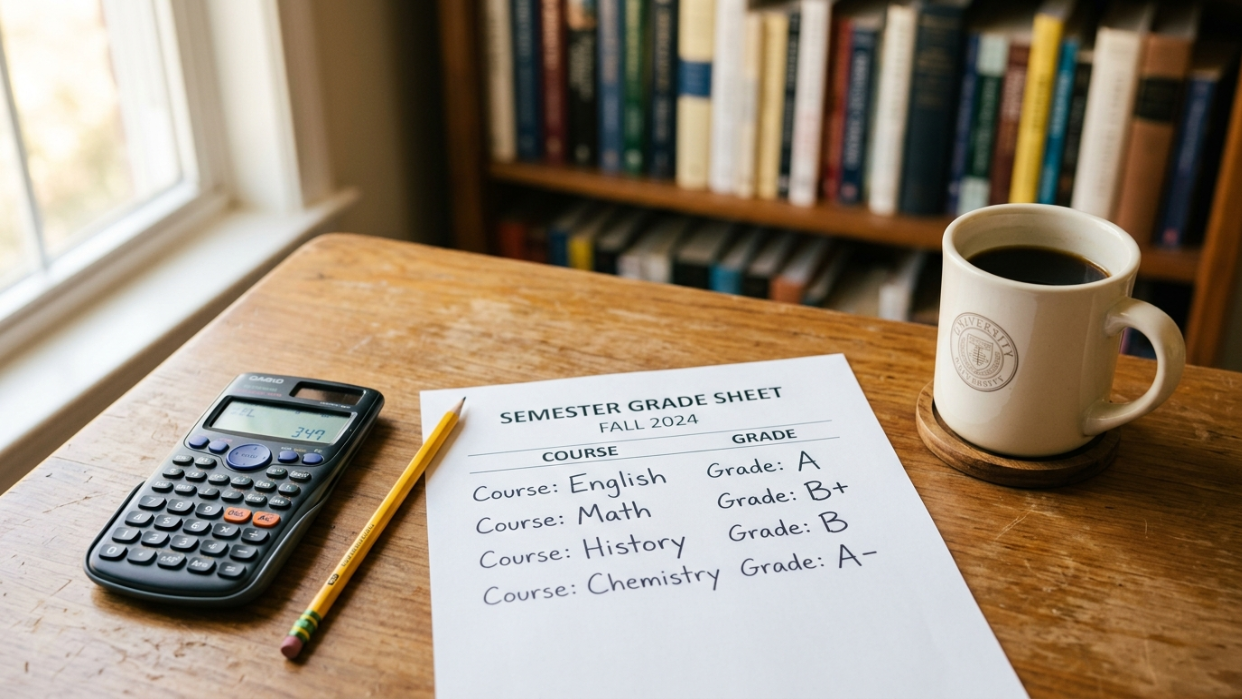
Your semester GPA is, honestly, one of the most important numbers you will see on your college transcript. It kind of represents how you did academically for one single term— fall, spring, or summer. Unlike your cumulative GPA, which folds in every class you have ever taken, your semester GPA is basically showing how you performed during that particular slice of time
Once you understand how to calculate your semester GPA, you get real power. You can keep a close eye on your progress while the term is still going, you can estimate where you might land before grades are posted, and you can make smarter choices for your academic future too
In this guide, I’m going to take you through exactly how a GPA calculator for semester grades works. You’ll see the straightforward math used in the calculation, you’ll learn how credit hours meaningfully affect your GPA, and you’ll find out how to use online tools so the whole process becomes fast and— more or less error free
What Is a Semester GPA and Why Does It Matter?
A GPA is the average of a particular academic term or semester. It shows your performance for a specific semester only; not for other semesters or for future semesters. This is not your overall GPA (cumulative) that reflects all of your classes over many semesters.
Why Semester GPA is very important:
Academic Standing: Semester GPA is significant for getting on the Dean’s List, academic probation or for honors eligibility. A good half-term can make you more confident and more doors will open.
Semester Minimum GPA requirements for Scholarship Eligibility: Scholarship applications may be based on a minimum GPA for the entire semester in some instances. Students who obtain a low grade point average may lose their funding.
Transfer Applications: They will be considering your grades on a semester by semester basis for transfer applications to look at trends.
Personal Progress Tracking: Semester GPA will provide feedback on your progress. You should make certain changes in your semester grade average if you have a low average. If you have an average grade for the first half of the semester, you’re doing well.
At the end of the term, students will be able to look at their semester Grade Point Average (GPA) to determine the success of the term. It gives instant feedback to students on their academic performance.
The Simple Formula for Semester GPA Calculation
The formula for calculating your semester GPA is straightforward. You do not need to be a math expert to understand it.
The Formula:
Semester GPA = Total Quality Points ÷ Total Credit Hours Attempted
Here is what each part means:
- Quality Points: The points you earn for each course. You get these by multiplying your grade points by the credit hours for that class.
- Credit Hours: The number of credits each course is worth. A typical class is 3 credits, but some labs or seminars might be 1 or 4 credits.
The reason this works is that semester GPA is a weighted average. A 4-credit class affects your GPA more than a 1-credit class, so not every course counts equally .
Step-by-Step Guide to Calculate Your Semester GPA
Let me break this down into clear steps that anyone can follow.
Step 1: List All Your Courses
Write down every class you took during the semester. Include the name of each course and the number of credit hours it is worth.
Step 2: Record Your Letter Grades
Write down the letter grade you received in each course. This might be A, B, C, D, or F, with plus and minus variations.
Step 3: Convert Letter Grades to Grade Points
Assign grade points to each letter grade, based on the standard 4.0 scale. The most widely used scale used by US colleges is the following one :
| Letter Grade | Grade Points |
| A+ or A | 4.0 |
| A- | 3.7 |
| B+ | 3.3 |
| B | 3.0 |
| B- | 2.7 |
| C+ | 2.3 |
| C | 2.0 |
| C- | 1.7 |
| D+ | 1.3 |
| D | 1.0 |
| F | 0.0 |
Important: Some schools do not use plus and minus grades. Others might use a slightly different scale. Always check your school’s specific grading policy .
Step 4: Calculate Quality Points for Each Course
Multiply each course’s grade points by its credit hours.
Formula:
Quality Points = Grade Points × Credit Hours
Step 5: Add Up All Quality Points
Add together the quality points from every course you took this semester.
Step 6: Add Up All Credit Hours
Add together the credit hours for every course you took this semester.
Step 7: Divide
Divide your total quality points by your total credit hours.
Formula:
Semester GPA = Total Quality Points ÷ Total Credit Hours
Step 8: Round to Two Decimal Places
The final result is usually rounded to two decimal places .
Real Example of Semester GPA Calculation
Let me show you how this works with actual numbers.
Suppose you completed four courses in one semester:
| Course | Credits | Letter Grade | Grade Points | Quality Points |
| English | 3 | A | 4.0 | 12.0 |
| Calculus | 4 | B+ | 3.3 | 13.2 |
| History | 3 | B | 3.0 | 9.0 |
| Chemistry Lab | 2 | A- | 3.7 | 7.4 |
Step 1: Calculate quality points for each course:
- English: 3 × 4.0 = 12.0
- Calculus: 4 × 3.3 = 13.2
- History: 3 × 3.0 = 9.0
- Chemistry Lab: 2 × 3.7 = 7.4
Step 2: Add all quality points:
12.0 + 13.2 + 9.0 + 7.4 = 41.6
Step 3: Add all credit hours:
3 + 4 + 3 + 2 = 12
Step 4: Divide:
41.6 ÷ 12 = 3.466…
Step 5: Round to two decimal places:
Your semester GPA is 3.47 .
This semester GPA reflects your performance during this term of school. It is not part of your overall GPA (combination of all your semesters).
Common Mistakes When Calculating Semester GPA
Avoid these errors to make sure your GPA calculation is accurate.
Mistake 1: Averaging Grades Directly
Some students attempt to add up the letter grades and then divide by the number of classes. This won’t work because it does not account for credit hours. A 4-credit grade of “B” is not equivalent to a 2-credit grade of “B.”
Mistake 2: Using the Wrong Grade-Point Scale
There are a variety of scales, depending on the school. Some have plus and minus grades and some don’t. Always check your school’s particular scale before working out .
Mistake 3: Forgetting to Include All Courses
Be sure to list all of the courses you were enrolled in for the semester. Your GPA is affected by not attending any class.
Mistake 4: Ignoring Credit Hours
All credits are not equal. A 4 credit class is worth more than a 1 credit class. Never add grade points, always add grade points times credit hours.
Mistake 5: Math Errors
If you add or divide incorrectly, you can alter your GPA. Verify work; use a calculator tool to prevent mistakes.
How a GPA Calculator for Semester Grades Makes It Easier
Now you can do your own GPACalculation for your Semester. You don’t need to do the calculations again each time. A GPA calculator for semester grades can streamline the entire process.
Here is how an online GPA calculator works:
Step 1: Enter your course names (optional but helpful for tracking).
Step 2: Enter the credit hours for each course.
Step 3: Select your letter grade for each course from a dropdown menu.
Step 4: Click calculate.
Step 5: The tool instantly shows your semester GPA .
The benefits of using a GPA calculator:
- Speed: Manual calculation takes time. A calculator gives results instantly.
- Accuracy: No math errors. No forgetting to multiply or divide.
- Convenience: You can use it anywhere – on your phone, tablet, or computer.
- Flexibility: Try different scenarios. What if you get an A instead of a B in one class? You can see the result immediately.
Many universities provide an online GPA calculator on their websites. Students can enter their grades and credit hours into these tools to quickly calculate their semester GPA .
Semester GPA vs Cumulative GPA
Understanding the difference between these two is essential.
Semester GPA: Covers only one academic term. It shows how you performed in that specific semester .
Cumulative GPA: Includes every course you have taken since you started college. It is the average of all your semesters combined .
Here is why both matter:
- Your semester GPA kinda gives quick feedback , you know, not the whole story, but at least it helps. You can check right away if you improved or if you kinda went down compared with last semester.
- Your Cumulative GPA is kind of like the whole academic record, rolled up in one number. Colleges, employers, and scholarship committees tend to check that number, even if it is not the only thing they consider.
- Semester GPA can move pretty fast, its based on fewer credits so it shifts quicker. Meanwhile cumulative GPA drifts slowly, because it folds in many semesters so the whole thing feels more steady.
For instance, if your cumulative grade point average is 3.0 with 60 credit hours and you earn 4.0 for one semester, the cumulative grade point average will go up just a little bit.
What About Weighted Semester GPA?
Some high schools and colleges use weighted GPAs. This system gives extra points for harder classes like AP, Honors, and IB courses .
On a weighted scale:
- A regular class A = 4.0 points
- An Honors class A = 4.5 points
- An AP/IB class A = 5.0 points
The calculation works the same way. You just use weighted grade points instead of standard ones.
Example of Weighted GPA Calculation:
| Course | Type | Credits | Grade | Weighted Points | Quality Points |
| AP English | AP | 3 | A | 5.0 | 15.0 |
| Honors Math | Honors | 4 | B+ | 3.8 | 15.2 |
| Regular Science | Regular | 3 | A | 4.0 | 12.0 |
Total Quality Points = 15.0 + 15.2 + 12.0 = 42.2
Total Credits = 3 + 4 + 3 = 10
Weighted GPA = 42.2 ÷ 10 = 4.22
When to Calculate Your Semester GPA
There are several times when calculating your semester GPA is especially helpful:
Before the Semester Ends
Calculate your estimated GPA while you still have time to improve. If you know you need a higher grade in one class, you can work harder before finals.
After Receiving Final Grades
Check your official semester GPA against your own calculation. If there is a discrepancy, you can ask your professor or registrar to review your grades.
Before Applying for Scholarships
Many scholarships require a minimum semester GPA. Calculate your GPA early to make sure you meet the requirements.
Planning for Next Semester
Use your semester GPA to set goals for next term. If you got a 3.2, aim for a 3.5. If you got a 2.8, decide what you need to change.
Types of Courses That Do Not Affect GPA
Not every course counts toward your semester GPA. Here are common exceptions:
Pass/Fail Courses : if you end up taking something as pass/fail, your GPA is basically not touched. A “Pass” also comes with no assigned grade points so it kind of just sits there. A “Fail” usually won’t change your GPA either, but double-check your school’s policy.
Withdrawals (W) : when you withdraw from a class it generally does not affect GPA, though it will still show up on your transcript.
Incomplete (I) : an incomplete grade doesn’t count in your GPA until it gets updated into a final grade. After that, when the incomplete is finally resolved, it retroactively changes your GPA .
Credit/No Credit (CR/NC) : most of these courses do not impact GPA . they’re meant to nudge exploration, without the usual weight of grades.
How EzGrader Tools Fit Into Semester GPA Calculation
Semester GPA depends on test and homework grades. To be able to compute your semester GPA, you must know the grades that you obtained in each subject.The EZ Grader calculator will help you monitor your performance in each test and exam in a semester. Here is how:Checking Your Test Grades.
Use the EZ Grader calculator to put in the total number of questions asked in your test/exam and the number of questions answered wrongly to know your percentage and letter grade.Exam Grade Chart: The calculator provides a comprehensive exam grade
chart which includes all possible numbers of wrong answers and corresponding grades. With the grade chart, you can know beforehand what you should score in the exam.Test Grade Calculator: The test calculator helps you monitor your progress in each test. Avoid waiting for report cards. Monitor your grades after each test/exam.
Preparing for Exam: By using the GPA calculator, you can learn the number of marks required in the exam to attain your desired GPA for the semester. Since you already have knowledge about the marks scored in your tests, you can now find out your GPA by using the GPA calculator.
Frequently Asked Questions About Semester GPA
1. What is the difference between semester GPA and cumulative GPA?
Semester GPA refers to the grade point average of just one term. This term could be the fall term or the spring term, and semester GPA covers only the grades from those classes. The cumulative GPA refers to the grade point average of all the semesters combined. This includes all the classes you have attended since the beginning of your college life.
2. How many credit hours do I need for a semester GPA?
To calculate your GPA per semester, you must complete a minimum of one credit hour. However, most students will take either 12 or 18 credits per semester. Semester GPA is calculated using all the courses that were completed that semester and not those that were supposed to have been taken. In case you withdraw from all your courses or register for all your courses on Pass/Fail Basis, then there won’t be any GPA for that semester.
3. Can I calculate my semester GPA before the semester ends?
Your semester GPA can be determined at any time. However, for an accurate calculation of GPA, the most effective method would be to take into account the current grades, match them to the GPA points chart, and make a prediction regarding your GPA. Yet, you will need to wait until your grades get online to be sure about them.
4. Do transfer credits affect my semester GPA?
Transfer credits from other colleges normally will not have an impact on your semester GPA for your present college. This is because even though you get transfer credits, the GPA will not include the marks earned through those transfer credits. It is possible that transfer credits may affect your cumulative GPA based on your school’s transfer policy.
5. Why is my semester GPA different from my major GPA?
GPA for the semester includes all the classes taken by the student during the semester irrespective of their being elective or core. GPA for major is calculated based on the courses included within the major courses only for the particular major selected. GPA for major may be lower or higher than GPA for the semester.
How Do You Calculate Final Grades?