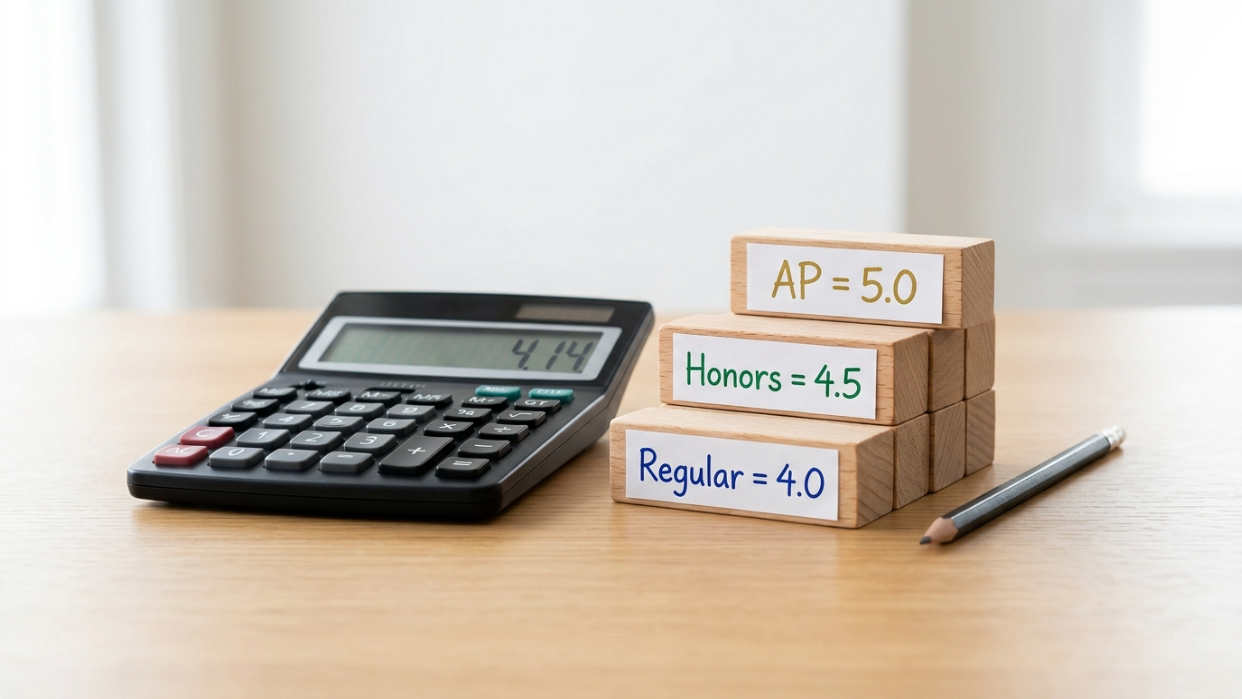
The GPA is the most important number in your academic experience, like honestly it ends up mattering a lot. Colleges look at it. It is mandatory when applying for scholarships and it’s also used to look at graduate programs.But, the GPA is calculated differently in many situations. So if you are taking AP, Honors, and/or IB classes, you should be aware of weighted grades, and how that affects your GPA.
A weighted GPA lets you get additional points for more challenging classes , which means that it is possible to end up with a GPA above 4.0. If you learn how to calculate your GPA with those weights, you can keep track of your progress and set realistic goals for yourself.
What Is a Weighted GPA?
This refers to a GPA whereby the grade point average tries to incorporate the level of difficulty in the course the student actually takes.
The idea itself is pretty clear, students who choose more challenging courses like AP, Honors , and IB should get credit for it, and their GPA ends up reflecting that pressure a bit. That’s what people call the weighted GPA.
This happens because admission officers from a variety of colleges are always watching for transcripts that show academic excellence where the coursework looks demanding. For example, a student with a 3.8 weighted GPA who has taken several AP courses would be seen as more favorable than a student with a 4.0 unweighted GPA who only did the regular basic courses.
Weighted vs Unweighted GPA: What Is the Difference?
This is one of the most common questions students ask. Let me break it down clearly.
Unweighted GPA:
- Uses a 0.0 to 4.0 scale
- Every class counts the same
- An A in Gym = 4.0
- An A in AP Physics = 4.0
- Maximum possible is 4.0
Weighted GPA:
- Uses a 0.0 to 5.0 scale (or higher)
- Harder classes get extra points
- An A in regular class = 4.0
- An A in AP class = 5.0
- Maximum possible can be 5.0 or more
US high schools have adopted weighted GPAs due to the increase in the number of students taking AP classes. Weighted GPAs are intended to take into account the extra effort involved in taking such classes.
How Does the Weighted GPA Scale Work?
Different schools use different weighted scales. There is no single national standard. Here are the most common systems.
Common 5.0 Scale:
| Grade | Regular Class | Honors Class | AP/IB Class |
| A | 4.0 | 4.5 | 5.0 |
| B | 3.0 | 3.5 | 4.0 |
| C | 2.0 | 2.5 | 3.0 |
| D | 1.0 | 1.5 | 2.0 |
| F | 0.0 | 0.0 | 0.0 |
Another Common Weighted Scale:
Some schools use a different method. For example, one school district uses these weights for grades 11-12 :
| Grade | College Prep (Unweighted) | AP/IB/DE/Honors (Weighted) |
| A+ | 4.00 | 5.00 |
| A | 4.00 | 5.00 |
| A- | 3.70 | 4.70 |
| B+ | 3.30 | 4.30 |
| B | 3.00 | 4.00 |
| B- | 2.70 | 3.70 |
The exact numbers depend on your school. Always check your school’s specific grading policy .
How to Calculate GPA with Weighted Grades: Step by Step
Now let me show you exactly how to calculate GPA with weighted grades. The process is similar to unweighted GPA but uses different point values.
Step 1: List all your courses and their credit hours
Write down every class you took during the semester or academic year. Include the credit hours for each course. Most high school classes are worth 1 credit per year or 0.5 credits per semester.
Step 2: Record your letter grades
Write down the letter grade you received in each course.
Step 3: Identify which classes are weighted
Mark which courses are AP, Honors, or IB. These will get extra points.
Step 4: Convert letter grades to weighted grade points
Use your school’s weighted grading scale. Here is a common example:
| Letter Grade | Regular Class | Honors Class | AP/IB Class |
| A | 4.0 | 4.5 | 5.0 |
| A- | 3.7 | 4.2 | 4.7 |
| B+ | 3.3 | 3.8 | 4.3 |
| B | 3.0 | 3.5 | 4.0 |
| B- | 2.7 | 3.2 | 3.7 |
| C+ | 2.3 | 2.8 | 3.3 |
| C | 2.0 | 2.5 | 3.0 |
| C- | 1.7 | 2.2 | 2.7 |
| D | 1.0 | 1.5 | 2.0 |
| F | 0.0 | 0.0 | 0.0 |
Step 5: Multiply grade points by credit hours
For each course, multiply the grade points by the number of credit hours. This gives you the quality points for that course .
Formula: Quality Points = Grade Points × Credit Hours
Step 6: Add all quality points
Add together the quality points from every course.
Step 7: Add all credit hours
Add together the total credit hours for all courses.
Step 8: Divide
Divide your total quality points by your total credit hours.
Formula: Weighted GPA = Total Quality Points ÷ Total Credit Hours
Real Example: Calculating Weighted GPA
Let me show you exactly how this works with real numbers. A student takes five courses in one semester:
| Course | Type | Credits | Grade | Grade Points | Quality Points |
| AP English | AP | 1 | A | 5.0 | 5.0 |
| Honors Math | Honors | 1 | B+ | 3.8 | 3.8 |
| Regular Science | Regular | 1 | A | 4.0 | 4.0 |
| AP History | AP | 1 | B | 4.0 | 4.0 |
| Regular Spanish | Regular | 0.5 | A- | 3.7 | 1.85 |
Step 1: Multiply grade points by credit hours
- AP English: 5.0 × 1 = 5.0
- Honors Math: 3.8 × 1 = 3.8
- Regular Science: 4.0 × 1 = 4.0
- AP History: 4.0 × 1 = 4.0
- Regular Spanish: 3.7 × 0.5 = 1.85
Step 2: Add all quality points
5.0 + 3.8 + 4.0 + 4.0 + 1.85 = 18.65
Step 3: Add all credit hours
1 + 1 + 1 + 1 + 0.5 = 4.5
Step 4: Divide
18.65 ÷ 4.5 = 4.14
Weighted GPA: 4.14
This student has a weighted GPA of 4.14, which is above the traditional 4.0 maximum.
How to Calculate Unweighted GPA Alongside Weighted GPA
There are times you would want to find out your weighted and unweighted GPA. The unweighted GPA does not take into account course difficulty and is based on a standard 4.0 point system.
To calculate your unweighted GPA, use the same formula but with unweighted grade points:
| Letter Grade | Unweighted Points |
| A+ or A | 4.0 |
| A- | 3.7 |
| B+ | 3.3 |
| B | 3.0 |
| B- | 2.7 |
| C+ | 2.3 |
| C | 2.0 |
| C- | 1.7 |
| D | 1.0 |
| F | 0.0 |
Example of the same student with unweighted points:
| Course | Credits | Grade | Unweighted Points | Quality Points |
| AP English | 1 | A | 4.0 | 4.0 |
| Honors Math | 1 | B+ | 3.3 | 3.3 |
| Regular Science | 1 | A | 4.0 | 4.0 |
| AP History | 1 | B | 3.0 | 3.0 |
| Regular Spanish | 0.5 | A- | 3.7 | 1.85 |
Total Quality Points: 4.0 + 3.3 + 4.0 + 3.0 + 1.85 = 16.15
Total Credits: 4.5
Unweighted GPA: 16.15 ÷ 4.5 = 3.59
Summary:
- Weighted GPA: 4.14
- Unweighted GPA: 3.59
The weighted GPA is significantly higher because the student took challenging courses.
Which GPA Do Colleges Look At?
Colleges look at both your weighted and unweighted GPA. But they care most about the rigor of your classes.
Here is what admissions officers actually consider :
- Course rigor is very important. They want to see that you challenged yourself with AP, Honors, or IB classes.
- Weighted GPA shows how well you performed in those challenging classes.
- Unweighted GPA shows your raw performance without course difficulty adjustments.
Many colleges recalculate applicants’ GPAs on an unweighted scale, then perform a rigor assessment to determine how many courses in that unweighted, recalculated GPA are honors or AP courses .
A student with a 3.8 unweighted GPA who took many AP classes is often more competitive than a student with a 4.0 unweighted GPA who took only easy classes. The rigor matters.
How to Use EzGrader to Track Your Weighted GPA
Since you have now learned how to calculate GPA with weighted grades, there is equipment you can use to make the calculation process easier for yourself.
The EZ Grader calculator allows you to quickly and conveniently verify your test scores. All you have to do is to enter the number of questions and the number of questions answered incorrectly, and the calculator will give you your percentage score and grade.
The grade chart shows the amount of incorrectly answered questions for each grade. This information allows you to plan your preparation for the test before it occurs.
You can use the test score calculator during the whole semester and the final grade calculator to determine the score you should achieve on your final exam.
Why Weighted GPA Matters for College Admissions
Why is weighted GPA important? It informs the college about your readiness to challenge yourself. Why does it matter? Let us explain.The university expects students who can cope with college-level material. By taking AP or IB classes, you prove your ability to do college-level work.
Weighted GPA rewards for taking risks. Students who take difficult classes get extra points in their GPA.It helps improve your class rank. In case there is a ranking at your school, your GPA with weighting will move you up to the top.
Weighted GPA can be helpful in getting scholarships. A lot of merit scholarships use weighted GPA.
Frequently Asked Questions
1. What is the highest possible weighted GPA?
It is determined by your particular school’s grade point system. Some schools have a scale of 5.0 as the highest, while some others have a maximum GPA of 4.5 or more. The highest achievable grade point average at a 5.0 scale school in Advanced Placement courses is 5.0.
2. How do I know which classes are weighted?
Check your school’s course catalog or ask your guidance counselor. Usually, AP, IB, and Honors classes are weighted. Some schools also weight dual enrollment and advanced courses.
3. Can I calculate my weighted GPA without knowing the exact weights?
You need to know your school’s specific weighted scale. Each school creates its own grading scale, and these vary widely from school to school .
4. Why is my weighted GPA different from my unweighted GPA?
Weighted GPA gives extra points for harder classes. If you take AP or Honors courses, your weighted GPA will be higher than your unweighted GPA. If you only take regular classes, they will be the same.
5. Do all colleges recalculate GPAs?
Not all colleges recalculate GPAs. In those cases, the admissions review involves a look at the GPA as reported by the high school, along with a rigor assessment . This means colleges still consider the difficulty of your courses.
Conclusion
Now you know exactly how to calculate GPA with weighted grades. The process is straightforward:
- Convert your letter grades to weighted grade points using your school’s scale
- Multiply grade points by credit hours to get quality points
- Add all quality points together
- Add all credit hours together
- Divide total quality points by total credit hours
The formula is:
Weighted GPA = Total Quality Points ÷ Total Credit Hours
Calculating GPA on a weighted basis will enable you to monitor your performance and help you set realistic targets. Harder courses can positively impact your weighted GPA, and thereby increase your chances of college admission.
How Do You Calculate Final Grades?