A student correctly calculates acceleration from a velocity–time graph, then uses the final velocity to calculate the distance traveled. Another gets the distance right but cannot explain what the graph’s slope means. Give both students the same total score, and those different learning needs can disappear.
A useful IB Physics quiz makes those differences visible. Start with one learning goal, choose questions that expose the reasoning behind an answer, and decide what you will do with the results. The following approach uses a short kinematics check that teachers can adapt to the material their class has covered.
Start with a decision you need to make
Before collecting questions, finish this sentence: “After this quiz, I need to know whether students can…”
For a class working on motion graphs, the answer might be: “distinguish a graph’s slope from the area beneath it, and connect each to a physical quantity.” That is specific enough to guide question selection and the next lesson.
“Understand mechanics” is too broad for a brief check. A mixed-topic quiz can be useful for revision, but it makes a poor diagnostic if you cannot tell which idea caused an error. Keep the scope appropriate to the class’s Standard Level (SL) or Higher Level (HL) course and the content already taught.
The quick planning sequence is: define the skill, choose contrasting question demands, prepare answer guidance, and plan a follow-up task.
Build an IB Physics quiz around different kinds of evidence
For a roughly 15-minute classroom check, you could use this teacher-designed outline. The timing is a starting point to adjust for your students, not an official IB requirement.
| Task | What the student does | What the response can reveal |
| Interpret | Describes motion from a velocity–time graph | Whether the axes and changing velocity are understood |
| Calculate | Finds acceleration and displacement | Whether slope and area are distinguished |
| Explain | Evaluates an incorrect distance calculation | Whether the student can justify a method |
| Transfer | Applies the same ideas to a changed graph | Whether understanding extends beyond one familiar example |
These tasks can share a context, but avoid making every answer depend on a correct first calculation. Otherwise, one early mistake may conceal what the student understands elsewhere.
Write the answer guidance alongside the questions. For an explanation, identify the idea you need to see rather than demanding one memorized sentence. For a calculation, decide how you will recognize a sensible method when the arithmetic goes wrong. This makes the quiz easier to interpret when you mark it, especially if two teachers share the class.
When looking for additional material, the EduNinja IB Physics HL question bank provides a topic-organized starting point. Inspect each question and its available answer guidance before assigning it. The linked page is for HL; select the appropriate level for an SL class, and check historical questions against the content and format you intend to assess.
Use one small example to expose a misconception
Here is an original classroom example, not an official IB question:
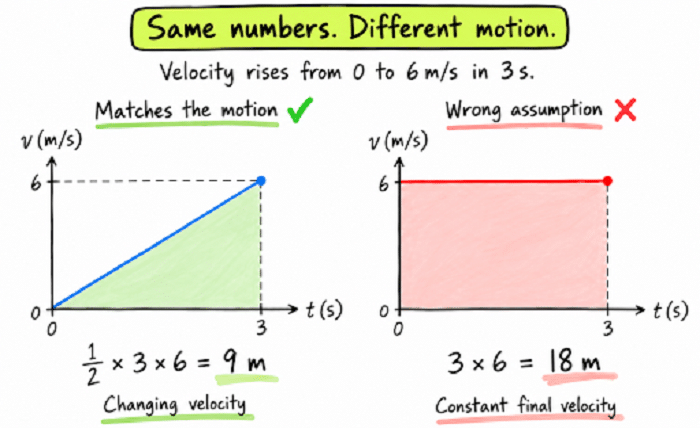
An object moves in a straight line. Its velocity increases uniformly from 0 m/s to 6 m/s in 3 s.
Ask students to sketch the velocity–time graph, calculate the acceleration, and determine the displacement during those three seconds. Then give them a claim to evaluate: “The object travels 18 m because distance equals speed multiplied by time.”
The acceleration is the graph’s slope: (6 − 0) ÷ 3 = 2 m/s². The displacement is the triangular area under the graph: ½ × 3 × 6 = 9 m. Velocity is non-negative throughout, so the distance traveled is also 9 m.
The 18 m calculation incorrectly treats the final velocity as constant throughout the interval. A student who explains that mistake has shown more than the ability to substitute numbers into a formula. They have connected the calculation to the physical model.
Original teaching illustration. The rectangle represents a different motion model: a constant velocity of 6 m/s throughout. It does not match the stated motion.
Ask for reasoning before revealing the answer
Collect a brief written justification before discussing the calculation. “I used the triangle because the velocity starts at zero and increases uniformly” gives you evidence that “I used the formula” does not. If a student writes 18 m, ask them to show the area that their calculation represents. The rectangle makes the hidden constant-velocity assumption visible without requiring a longer numerical problem.
You can also ask whether the answer should be less than, equal to, or greater than 18 m before anyone calculates. Here, the object moves more slowly than 6 m/s for nearly the whole interval. That comparison gives students a way to check their result against the situation rather than relying only on arithmetic.
Assemble the set, then review it as a student
Once you have chosen the learning goal and question mix, arrange the selected questions in a sequence students can follow. Begin with an interpretation task, then ask for a calculation and a reasoned explanation. Note the source of each question in your planning copy so you can return to its answer guidance and check whether it suits the intended course level.
Review the assembled set for repeated calculations, missing information, and questions that require content you have not taught. Read the diagrams at the size students will see them. Check that labels and units are legible and that any supplied values support the intended method.
Keep a separate answer guide ready before using the quiz. Check that it explains the physical reasoning as well as giving numerical answers. A teacher-selected practice set should not be presented as an official paper or as proof of complete syllabus coverage.
Keep the quiz fair and interpretable
State whether students may use a calculator and which reference materials are available. Use familiar notation unless interpreting unfamiliar notation is part of the intended task. A motion-graph check should not accidentally become a test of whether students can decipher a crowded diagram or a paragraph of unnecessary context.
Check question order, too. An explanation printed early in the quiz might give away the reasoning needed for a later calculation. Conversely, a long calculation at the start may leave some students too little time to attempt the conceptual questions. Read the complete set in order and consider where a student might get stuck.
If you offer an extension, label it clearly and record its outcome separately from the core check. That lets you stretch students who are ready without confusing difficulty with the specific understanding the quiz was designed to measure.
Mark for the next lesson
Record the total score if it serves your classroom purpose, but also note the kind of error. For the example above, useful categories include confusing slope with area, treating a changing velocity as constant, and omitting units.
Use those patterns to choose the next action. A student who confuses slope and area may need to annotate a graph before calculating. Someone who understands the graph but makes an arithmetic slip needs a different response. After feedback, use a fresh graph to check whether the correction transfers. Repeating the original question alone may show that a student remembers the answer.
For example, one student might find the acceleration correctly but use a rectangle for displacement. Another might choose the triangle correctly and then forget the factor of one-half. Both could submit an incorrect distance, yet the first response calls for a discussion of the motion model while the second may need a calculation check. Keep the written working with the score so that distinction is not lost.
Use a changed graph for the follow-up
For an original follow-up task, let velocity increase uniformly from 2 m/s to 6 m/s over 4 s. Ask students to sketch the graph and find the displacement. The area is now a trapezoid: the average velocity is (2 + 6) ÷ 2 = 4 m/s, giving a displacement of 16 m. They can also split the area into a rectangle and a triangle.
Ask why a triangle on its own no longer works. The nonzero initial velocity is the important change; a response that notices it provides better evidence of transfer than a correct number alone. Compare each student’s explanation with their earlier mistake, then decide whether to revisit graph interpretation or move on to a different application.
Common planning questions
How many questions should a short Physics quiz contain?
Choose enough to distinguish the skills you are checking. Four focused tasks may be more informative than ten similar calculations. Estimate the time needed for reading, diagrams, working, and explanations, then adjust after using the quiz with your class. Question count alone does not describe the workload.
Should I convert the result into an IB grade?
A narrow classroom quiz is better used to identify specific strengths and gaps. An official assessment’s grade boundaries do not establish an equivalent grade for a short custom set. If you report a percentage, explain what the quiz covered and use the students’ reasoning to guide feedback.
What should students do after the quiz?
Ask them to correct one identified error, explain why the original approach failed, and attempt a new question testing the same idea. That gives the next lesson a clear purpose: checking whether a change in reasoning survives a change in context.